
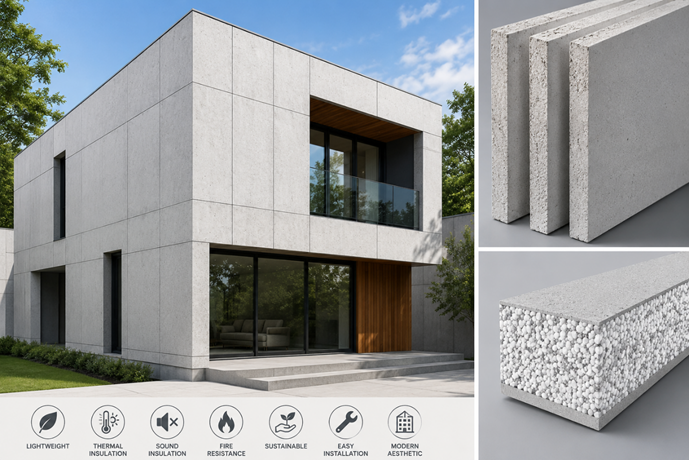
As per latest research by Growth Market Reports, the global architectural lightweight concrete panel market size stood at USD 4.99 billion in 2025. The market is witnessing robust expansion, propelled by a compound annual growth rate (CAGR) of 6.9% from 2026 to 2034. By the end of the forecast period in 2034, the market is projected to reach USD 9.18 billion. This growth is primarily driven by surging demand for energy-efficient and sustainable building materials, accelerating urbanization, and the rising adoption of modern construction techniques across both developed and emerging economies.
The architectural lightweight concrete panel market is gaining momentum as the construction industry increasingly prioritizes efficient, durable, and visually adaptable building materials. Lightweight concrete panels combine the familiar strength of concrete with reduced structural weight, making them attractive for contemporary façades, partitions, wall systems, and architectural features.
Key Market Growth Drivers
Expansion of Prefabricated Construction
The growing use of prefabricated and modular construction is creating favorable conditions for architectural lightweight concrete panels. Panels manufactured away from the construction site can be transported and assembled according to project requirements, helping developers streamline installation and improve construction efficiency.
Government-backed infrastructure and housing initiatives are also encouraging the adoption of prefabricated technologies. Lightweight reinforced concrete sandwich panels, for example, are being explored for walls, floors, and roofs where faster construction and consistent quality are important.
Demand for Energy-Efficient Buildings
Energy performance has become an increasingly important consideration in architectural design. Lightweight concrete panel systems can contribute to improved thermal performance when combined with suitable insulation and building-envelope designs. Research indicates that prefabricated concrete sandwich panels can support thermal comfort while helping manage heating and cooling requirements.
Growing Preference for Lightweight Building Systems
Architects and contractors are increasingly exploring lightweight panel solutions to address construction timelines, transportation requirements, structural loads, and labor availability. Factory-produced panels can offer dimensional consistency and controlled manufacturing quality while reducing the amount of intensive work required at construction sites.
Research on prefabricated concrete panels highlights advantages including faster construction, reduced material waste, lower labor requirements, and manufacturing under controlled conditions. These characteristics align closely with the industry’s shift toward industrialized and off-site construction methods.
Architectural Flexibility and Aesthetic Appeal
Beyond structural and functional requirements, modern construction increasingly demands visually distinctive façades. Architectural lightweight concrete panels can be manufactured in different textures, finishes, shapes, and dimensions, allowing designers to develop customized exterior and interior surfaces.
This flexibility makes the technology suitable for commercial buildings, residential developments, hospitality projects, institutional facilities, and selected industrial structures. The ability to combine architectural appearance with functional performance is expected to remain an important factor supporting market adoption.
Challenges Facing the Market
Despite their advantages, lightweight concrete panels face several challenges. Manufacturing can require specialized equipment, technical expertise, and quality-control processes. Transportation and handling also need careful planning because panel dimensions and project-specific designs can create logistical complexities.
Another challenge is ensuring reliable performance at connections and joints. Research into prefabricated concrete sandwich panels continues to identify opportunities for improving structural connections, composite action, thermal behavior, and overall panel design.
Opportunities
Rising Demand for Sustainable Construction
The growing emphasis on sustainable buildings creates significant opportunities for architectural lightweight concrete panel manufacturers. Developers are increasingly seeking materials that reduce structural loads, minimize construction waste, and support energy-efficient building designs. Panels incorporating recycled aggregates, low-carbon binders, and other environmentally conscious materials could gain stronger acceptance as sustainability standards become more prominent.
Growth in Modular and Off-Site Construction
The expansion of modular, prefabricated, and off-site construction offers another promising opportunity. Lightweight concrete panels can be manufactured under controlled conditions and transported to construction locations for relatively efficient installation. This approach can help address labor shortages while supporting faster project schedules and consistent product quality.
Competitive Landscape
LafargeHolcim Ltd. (Holcim Group)
Saint-Gobain S.A.
James Hardie Industries PLC
Knauf Gips KG
Etex Group
CSR Limited
Nichiha Corporation
Xella Group (Hebel)
Aercon AAC
Sika AG
Future Outlook
The future of the architectural lightweight concrete panel market is closely linked to the evolution of sustainable construction, prefabrication, and high-performance building envelopes. Manufacturers are expected to focus on lighter formulations, improved insulation, durable finishes, recycled or alternative materials, and more efficient production processes. As developers seek construction systems that balance aesthetics, performance, sustainability, and installation efficiency, architectural lightweight concrete panels are positioned to become an increasingly important component of modern building design.
Source: https://growthmarketreports.com/report/architectural-lightweight-concrete-panel-market