
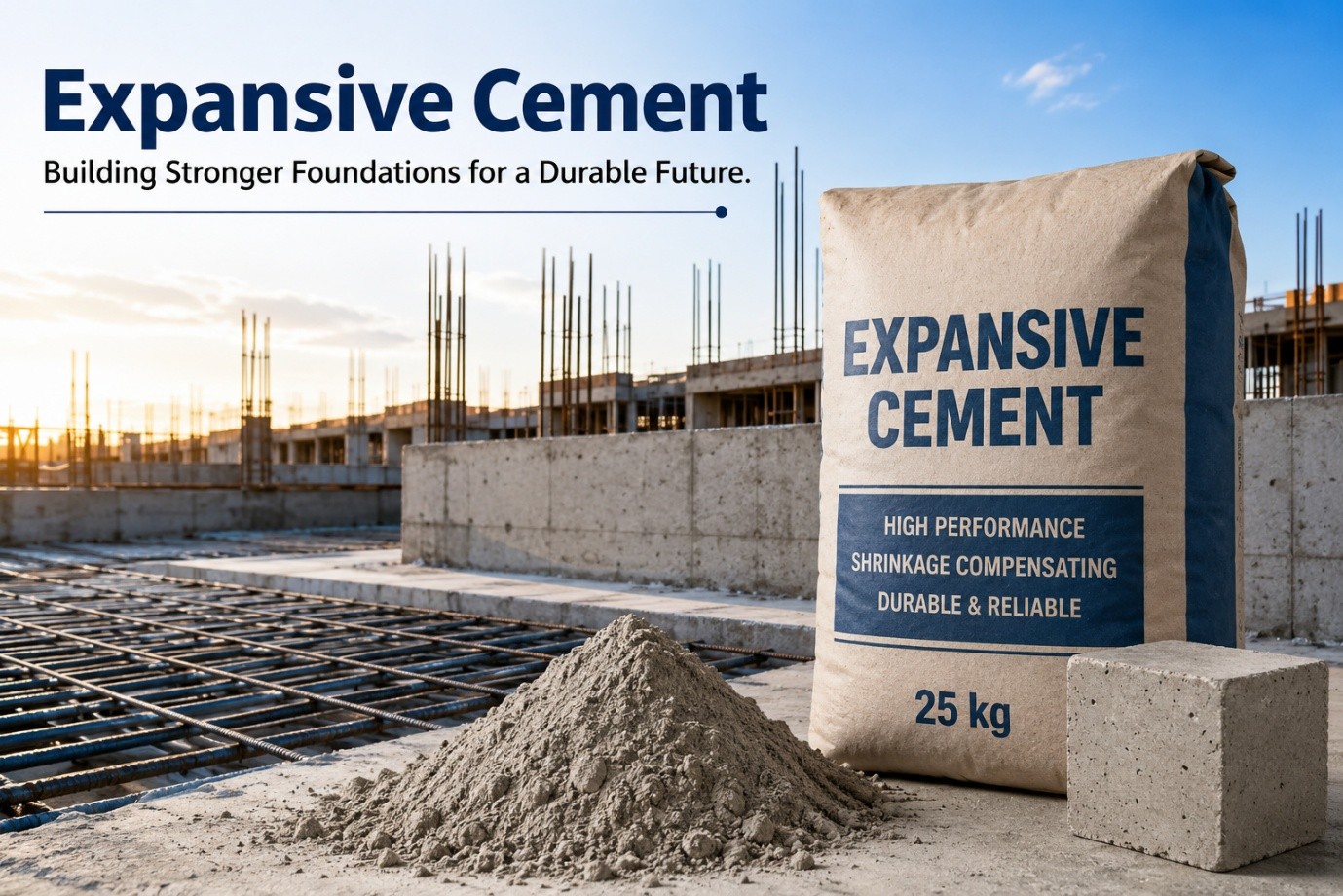
According to our Growth Market Report, the global expansive cement market size in 2025 stands at USD 4.54 billion, reflecting robust demand across key infrastructure and construction sectors. The market is projected to grow at a CAGR of 6.1% from 2026 to 2034, reaching an estimated USD 7.72 billion by the end of the forecast period. This growth is primarily fueled by increasing investments in infrastructure development, accelerating urbanization, and the rising need for durable construction materials that address the persistent challenges of shrinkage and cracking in concrete applications. The historical period from 2019 to 2024 demonstrated consistent demand resilience, even amid global supply chain disruptions, reinforcing the material’s critical role in modern construction.
Introduction: Why the Expansive Cement Market Is Gaining Global Attention
The global construction industry is entering a phase where durability, sustainability, and structural precision are more important than ever before. As urbanization accelerates and infrastructure projects become increasingly complex, traditional cement solutions are being challenged by advanced materials that solve long-standing engineering problems. Among these innovations, expansive cement has emerged as a high-performance construction material capable of minimizing shrinkage cracks while improving structural longevity.
The expansive cement market is expanding because modern construction no longer focuses solely on strength—it also emphasizes resilience, lifecycle performance, and reduced maintenance costs. Whether used in bridges, tunnels, industrial flooring, water-retaining structures, or precast concrete, expansive cement offers a reliable solution for projects where dimensional stability is essential.
What Is Expansive Cement?
Expansive cement is a specialized hydraulic cement formulated to undergo controlled expansion during the early stages of hydration. Unlike conventional cement, which naturally shrinks as it cures, expansive cement compensates for drying shrinkage by slightly increasing in volume before hardening completely.
This controlled expansion significantly reduces the likelihood of cracks, making it particularly valuable in structures where water tightness, durability, and long-term performance are critical.
Rather than replacing ordinary Portland cement across every application, expansive cement is strategically used in projects requiring superior crack resistance and enhanced structural integrity.
Why Is the Expansive Cement Market Growing Rapidly?
The demand for expansive cement is increasing because infrastructure developers are shifting from reactive maintenance strategies toward preventive construction techniques.
Modern governments and private developers recognize that repairing concrete damage over decades is considerably more expensive than preventing cracks during construction.
Several major trends are driving this market upward:
- Expansion of transportation infrastructure
- Growth in smart city developments
- Rising investment in industrial facilities
- Increasing construction of water reservoirs and dams
- Higher adoption of precast concrete technologies
- Growing awareness of lifecycle construction costs
- Demand for sustainable building materials
As infrastructure budgets continue increasing worldwide, materials that improve durability are becoming strategic investments rather than optional upgrades.
How Does Expansive Cement Work?
The unique performance of expansive cement comes from specially engineered compounds that generate controlled crystal growth during hydration.
As hydration occurs, expansive minerals produce internal expansion that offsets the natural shrinkage experienced by conventional concrete.
This balanced expansion creates multiple engineering advantages:
Reduced Shrinkage Cracks
One of the biggest causes of structural deterioration begins with microscopic shrinkage cracks. Expansive cement helps eliminate these weaknesses before they develop.
Improved Water Tightness
Crack reduction directly improves impermeability, making expansive cement ideal for reservoirs, sewage systems, tunnels, and underground infrastructure.
Better Reinforcement Bonding
The slight expansion creates improved contact between concrete and reinforcing steel, enhancing overall structural performance.
Increased Service Life
Structures constructed with expansive cement often require fewer repairs throughout their operational lifespan.
Major Applications Driving the Expansive Cement Market
Water Infrastructure
Water-retaining structures require exceptional crack resistance. Expansive cement helps maintain leak-proof performance in reservoirs, treatment plants, canals, swimming pools, and dams.
Transportation Infrastructure
Bridges, highways, airport pavements, railway platforms, and metro stations benefit from expansive cement because temperature fluctuations and heavy traffic create continuous stress.
Industrial Flooring
Manufacturing plants and logistics warehouses require flat, crack-resistant floors capable of supporting heavy machinery.
Expansive cement significantly improves floor durability while minimizing maintenance interruptions.
Precast Concrete
The precast construction industry increasingly adopts expansive cement to manufacture panels, pipes, bridge segments, and modular building components with improved dimensional stability.
Underground Construction
Tunnels, underground parking facilities, mining projects, and utility corridors require waterproof concrete capable of resisting ground pressure and moisture intrusion.
What Factors Are Fueling Global Market Expansion?
Massive Infrastructure Investments
Developing economies continue investing heavily in highways, airports, ports, energy projects, and public transportation systems.
These projects require advanced construction materials capable of delivering decades of reliable performance.
Urban Population Growth
Rapid urbanization is creating demand for high-rise buildings, commercial complexes, metro networks, and underground utilities.
Expansive cement supports modern urban infrastructure by reducing long-term structural maintenance.
Focus on Sustainable Construction
The construction industry increasingly evaluates materials based on lifecycle environmental impact rather than only initial cost.
By extending structural life and reducing repair frequency, expansive cement contributes to more sustainable infrastructure.
Technological Advancements
Manufacturers continue improving expansive cement formulations with enhanced consistency, faster strength development, and compatibility with modern concrete admixtures.
These innovations broaden application possibilities across multiple industries.
Emerging Trends Reshaping the Expansive Cement Market
Integration with High-Performance Concrete
Engineers increasingly combine expansive cement with high-performance concrete mixtures to achieve superior strength, durability, and crack resistance.
Smart Infrastructure Projects
Governments worldwide are investing in infrastructure designed for extended operational life.
Expansive cement supports these initiatives by reducing maintenance requirements over decades.
Growth of Modular Construction
Prefabricated buildings demand dimensional precision throughout manufacturing and installation.
Expansive cement improves component quality while minimizing manufacturing defects.
Advanced Manufacturing Techniques
Automation and digital quality control enable manufacturers to produce expansive cement with more consistent expansion characteristics and improved reliability.
Challenges Affecting Market Growth
Despite strong opportunities, several factors influence market expansion.
Higher production costs compared to conventional cement may limit adoption in highly price-sensitive projects.
Contractors unfamiliar with expansive cement may require additional technical guidance regarding proper mix design and curing practices.
Availability also varies across regions, making supply chain development an important factor for future market penetration.
However, increasing awareness of lifecycle cost savings continues encouraging broader adoption despite higher initial material costs.
Opportunities Creating the Next Growth Phase
The future presents numerous opportunities for manufacturers and construction companies.
Growing investment in climate-resilient infrastructure is expected to accelerate demand for durable construction materials.
Water conservation projects worldwide require leak-resistant concrete capable of performing under challenging environmental conditions.
The expansion of renewable energy facilities—including hydropower stations, wind turbine foundations, and energy storage infrastructure—also creates new application areas.
Furthermore, digital construction technologies, including Building Information Modeling (BIM) and predictive maintenance systems, increasingly prioritize materials with proven long-term performance, strengthening the value proposition of expansive cement.
Competitive Landscape
The expansive cement market continues evolving through innovation rather than volume competition alone.
Manufacturers are investing in:
- Advanced material research
- Sustainable production technologies
- Low-carbon cement formulations
- Improved hydration control
- Enhanced compatibility with chemical admixtures
- Region-specific product development
- Technical consulting services for large infrastructure projects
Future Outlook of the Expansive Cement Market
According to our Growth Market Report, The future of the expansive cement market appears highly promising as the global construction industry increasingly prioritizes resilient, sustainable, and low-maintenance infrastructure. Governments and private developers are expected to invest heavily in transportation networks, smart cities, renewable energy facilities, water management systems, and climate-resilient infrastructure, all of which require advanced concrete solutions with superior crack resistance and long service life. As engineering standards evolve toward lifecycle performance rather than initial construction costs, expansive cement is likely to gain wider acceptance across commercial, industrial, and infrastructure projects.
Source:- https://growthmarketreports.com/report/expansive-cement-marketglobal-industry-analysis