
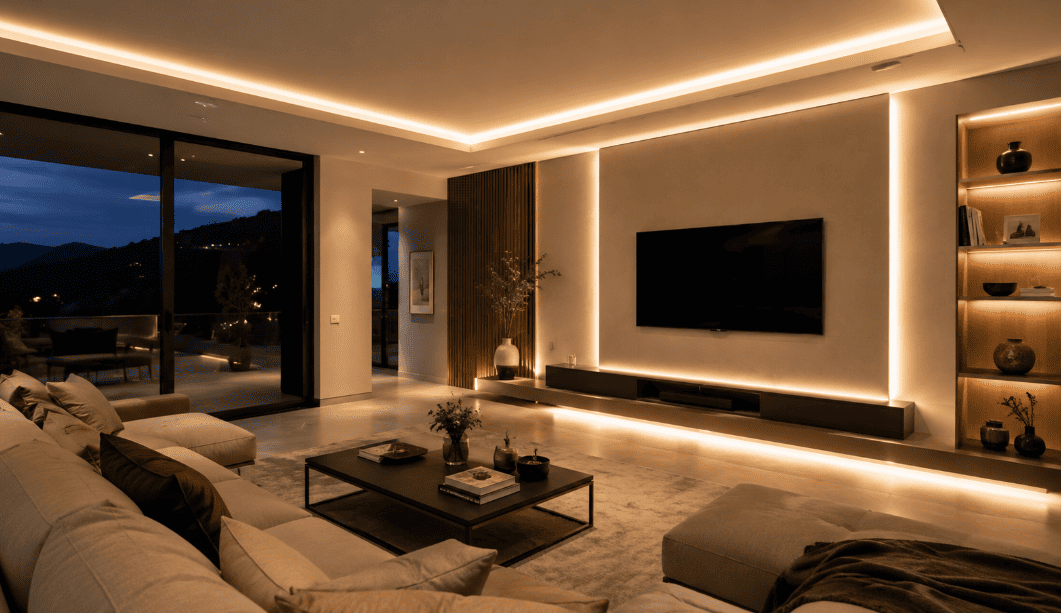
Choosing LEDUA interior lighting is easier when the project is defined in terms of use, mounting and electrical supply before individual models are compared.
What this product group is designed to do
Interior lighting works best as a layered system rather than a single central fixture. The LEDUA-brand interior section is divided into ceiling, desk, floor, linear, 5V and wall-mounted luminaires. Those families cover general light, task light, local accents and decorative layers, so the selection can be coordinated with room function, mounting points, furniture layout and the desired visual hierarchy.
In the LEDUA range, this page concentrates on ceiling, desk, floor, linear, 5V and wall-mounted luminaire groups within the LEDUA-brand interior range. It is relevant to homes, apartments, offices, studios, hospitality spaces and retail interiors. The category therefore has a narrower technical purpose than a general lighting page, which helps buyers compare products that share the same installation logic.
A room normally benefits from more than one lighting layer. General light provides overall visibility, task light supports reading, cooking or desk work, and accent light gives depth to walls, furniture and architectural details. Ledua interior lighting should therefore be judged by the role it plays in the room rather than by brightness in isolation.
Colour temperature also changes how finishes are perceived. Warm light reinforces timber and warm textiles, while neutral light gives a cleaner impression on white, stone and work surfaces. Where several fixture types share one room, keeping colour temperature and colour rendering reasonably consistent prevents the lighting from looking accidental.
Parameters to check before ordering
Use a written checklist instead of relying on a single headline specification. For LEDUA interior lighting, the following points are especially relevant:
- Visual scale: fixture dimensions should relate to ceiling height, furniture size and the room’s architectural lines.
- Lighting layer: decide whether the product provides general, task, accent or decorative light.
- Mounting point: ceiling, wall, floor, desk and linear fixtures require different cable positions and clearances.
- Light output and colour: match luminous flux and colour temperature to room size, surface colours and the visual task.
- Control: switches, dimming or smart control should be planned before finalising the luminaire type.
A practical way to apply LEDUA interior lighting
Start with one real zone instead of designing the whole project abstractly. In homes, apartments, offices, studios, hospitality spaces and retail interiors, mark the surface that actually needs light, the normal viewing direction and the nearest practical cable route. Then decide whether the light source should be visible, hidden behind a diffuser or concealed inside furniture or an architectural detail. That decision immediately narrows the suitable mounting formats and helps avoid spending on output that is lost in the wrong direction.
For this product group, the catalogue scope matters: ceiling, desk, floor, linear, 5V and wall-mounted luminaire groups within the LEDUA-brand interior range. Compare candidate products against the same short list of project conditions so that size, voltage, light colour and mounting are evaluated consistently. If several rooms or display units repeat the same detail, record the selected product and connection method as a standard project detail rather than re-selecting it each time.
Because this article focuses on a 5V product family, the supply architecture should be fixed before cable routes and controllers are finalised. Mixing voltages within one repeated detail creates avoidable service problems, so label supplies and connection points clearly when several systems share the same project.
Power-system considerations
A 5V system is useful for USB-powered, battery-adjacent and compact electronic projects. Voltage drop becomes noticeable quickly when current is high, so short feed lengths, adequate conductor size and multiple feed points are often more important than they are in higher-voltage systems.
Coordinate the electrical and mechanical design
Power supplies, controllers, connectors, cable routes and mounting hardware should be chosen together with LEDUA interior lighting. Confirm where each component will sit, how heat can escape and how a technician can reach it later. In repeated installations, use the same connector direction and cable entry wherever possible.
Measurements should come from the real site or furniture drawings. Note joints, hinges, ceiling voids, posts, shelves and other obstacles before final lengths are ordered. This turns product selection into a controlled installation detail rather than an on-site improvisation.
For the current LEDUA selection and product specifications, see https://leduastore.com/interior-lighting-ledua-brand/.
Final check
Choose LEDUA interior lighting by matching the product to the lighting task, physical dimensions, supply voltage, colour requirement, protection level and control method. The final choice should be based on the complete installed system, not a product image or wattage number alone.