

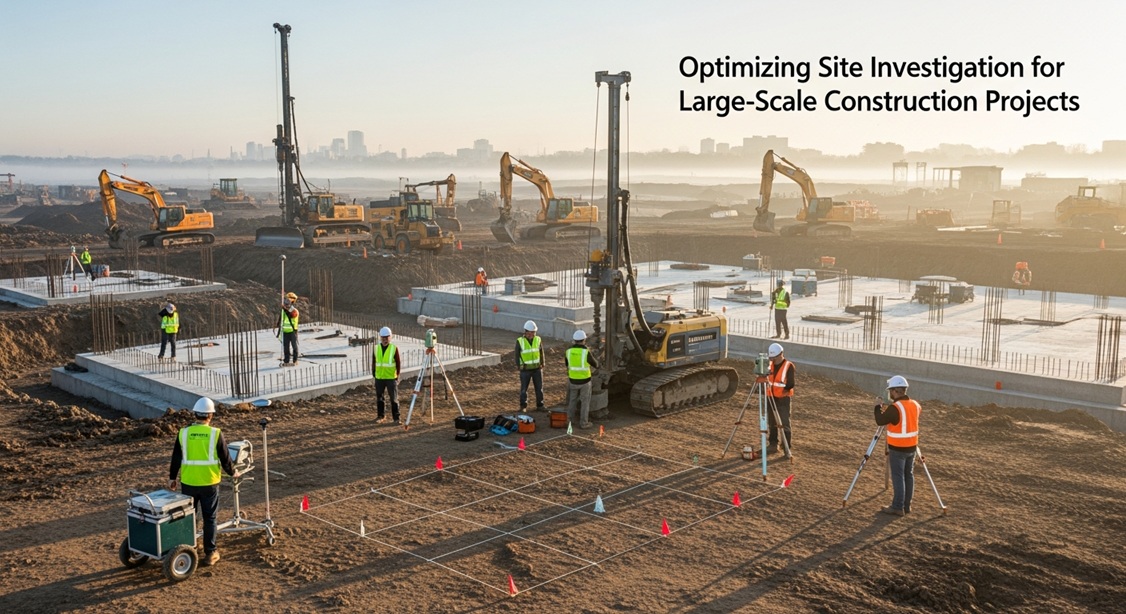
Optimizing site investigation for large-scale construction projects is one of those unglamorous tasks that quietly decides whether a megaproject is safe, on budget, and on schedule or a slow-motion disaster. Before any pile is driven or slab poured, the project team must transform an uncertain piece of ground into a quantified, modelled, and monitored engineering system. For large projects like dams, metros, airports, high-rise districts, industrial plants, coastal reclamations, this transformation is more complex than “a few boreholes and lab tests.” The subsurface is heterogeneous, the stakes are high, and the decision chain is long. Optimizing site investigation, therefore, means building a right-sized, risk-based, technology-enabled program that evolves throughout the project lifecycle.
This essay lays out a practical, advanced framework for optimizing site investigation at scale. It focuses on (1) goals and risk alignment, (2) staged investigation strategy, (3) integration of geotechnical, geological, hydrological, and environmental data, (4) advanced seismic technologies, (5) digital workflows and uncertainty management, (6) construction-phase verification and monitoring, and (7) the role of visual/remote sensing tools including the careful, ethical use of hidden cameras as a monitoring device in construction environments. The through-line is simple: investigate what matters most, at the resolution needed, when it is needed, using the best tools available and a learning-oriented workflow.
1. Why optimization matters more at a large scale
Large-scale construction projects introduce three multipliers of subsurface risk:
- Spatial multiplier: The footprint is big enough to cross multiple geomorphological zones. A metro line can pass through reclaimed land, river deposits, old floodplains, and weathered bedrock in one corridor. An industrial park can span a half-dozen soil formations.
- Structural multiplier: Mega-structures load the ground more intensely and in more varied ways (deep foundations, wide raft slabs, earthworks, tunnels, retaining systems). Many of these systems are sensitive to differential settlement, cyclic loading, or groundwater fluctuations.
- Economic multiplier: Small errors snowball. Underestimating a weak layer may trigger a redesign of piles for hundreds of columns. Over-conservatism can add millions in unnecessary ground improvement.
Optimization is not about “spending less on investigation.” It is about spending better. A well-optimized program often costs more up front, but saves far more in reduced redesign, fewer claims, less delay, and lower safety risk.
2. Core objectives of a modern site investigation program
An optimized investigation begins by being explicit about what decisions it must support. On large projects, investigation is not a single deliverable; it is a sequence of decision-support products. Typical objectives include:
- Ground model development: Defining stratigraphy, engineering units, and spatial variability.
- Parameterization: Estimating strength, stiffness, compressibility, permeability, and dynamic properties relevant to design.
- Hazard identification: Liquefaction, slope instability, karst, collapsible soils, expansive clays, soft organic deposits, faulting, landfills, UXO, contamination, etc.
- Construction feasibility: Excavatability, dewatering demand, tunneling conditions, pile drivability, temporary works needs.
- Baseline for claims: Establishing defensible ground conditions to manage contractual risk and disputes.
- Verification and monitoring plan: Identifying where observational methods or construction-phase tests will be essential.
Optimization means aligning each investigation activity with one or more of these objectives, then tailoring resolution and technology to risk.
3. Risk-based and staged investigation
3.1 A staged “learn-and-refine” approach
Large projects should not treat investigation as a single front-loaded burst. Instead, use a staged approach:
1. Desktop and reconnaissance stage
- Review existing maps, aerial imagery, historical land use, previous boreholes, seismic hazard datasets, remote sensing products, and hydrological records.
- Walkover surveys to map surface expressions: drainage, man-made fill, slopes, outcrops, sinkholes, etc.
- Output: preliminary risk register and conceptual ground model.
2. Feasibility and concept stage
- Target high-uncertainty/high-impact zones with sparse but strategic drilling and geophysics.
- Use broad-coverage methods (seismic, resistivity) to locate major boundaries.
- Output: corridor-level or site-level ground model with early parameter ranges; enables route/footprint selection.
3. Detailed design stage
- Dense, statistically-informed sampling to quantify variability within critical units.
- Specialized in situ tests for stiffness/dynamic response, groundwater behaviour, and creep/settlement
- Output: final design parameters with uncertainty bounds and design-line cross-sections.
4. Construction stage verification
- Observational method, instrumented test sections, pile load tests, probe drilling ahead of excavation/tunneling, and real-time geophysical checks.
- Output: validated ground model, adaptive construction controls.
3.2 Using risk to guide density and methods
Optimization uses risk ranking to decide where to invest. A simple but powerful tool is a ground risk matrix:
- Likelihood (heterogeneity, unknown history, conflicting evidence)
- Consequence (structural sensitivity, cost of change, safety exposure)
High-likelihood/high-consequence zones earn the highest investigation density and most advanced methods. Low-risk zones get basic confirmation drilling plus economical in situ tests.
4. Designing an effective sampling and testing plan
4.1 Borehole spacing and depth
Rules of thumb (“one borehole per hectare” or “every 50 m”) are crude for mega-projects. Better:
- Base spacing on geological variability.
- Homogeneous alluvial sand might need wider spacing; interbedded fill and peat need tighter spacing.
- Homogeneous alluvial sand might need wider spacing; interbedded fill and peat need tighter spacing.
- Depth based on the influence zone for the expected foundation or excavation.
- For high-rises, go deep enough to profile all compressible strata and reach competent bearing
- For tunnels, extend below the invert enough to identify weak layers affecting stability or settlement.
4.2 Smart use of in situ tests
Different tests give different “windows” into behaviour:
- CPTu (piezocone): High-resolution stratigraphy, undrained strength estimates, liquefaction screening, permeability indications.
- SCPTu / seismic CPT: Adds shear wave velocity for stiffness and seismic response.
- SPT: Useful in gravels and dense sands, but lower resolution and more operator variability.
- Pressuremeter/dilatometer: More direct stiffness and strength for deformation-controlled design.
- Vane shear: Essential for soft clays.
- Packer tests / Lugeon: Permeability in fractured rock.
- Test pits: Observations and bulk sampling in shallow heterogeneous fills and weathered zones.
An optimized program uses fewer redundant tests and more complementary ones.
4.3 Laboratory program tied to field reality
Lab tests should be selected based on which parameters are design-controlling and which soils are representative. Over-testing weakly relevant layers is a waste; under-testing critical ones is dangerous. Typical large-project lab suites include:
- Index tests (classification and correlations)
- Consolidation and creep tests for settlement-sensitive units
- Triaxial or direct shear for strength and critical state evaluation
- Cyclic tests for liquefaction or machine-foundation response
- Permeability tests, especially for dewatering or seepage structures
- Durability and abrasivity for tunneling in rock
Optimization also means strict sample quality protocols, thin-walled Shelby tubes for soft clays, freezing techniques in loose sands, triple-tube coring in weak rock, and well-documented disturbance assessment.
5. Integrating multiple disciplines into one ground model
Large-project failures often come from gaps between disciplines. A robust investigation integrates:
- Geology: Stratigraphy, structural features, weathering profiles, faults.
- Geotechnics: Engineering units and parameters.
- Hydrogeology: Aquifer boundaries, artesian pressures, seasonal variability.
- Geochemistry/environment: Aggressive groundwater, contamination, landfill gas, sulfate attack.
- Seismology: Site-specific response, fault rupture hazard, amplification effects.
The center of this integration is a 3D ground model that is updated in stages and shared across teams. A model is not “nice to have” at scale; it is a risk control.
6. Advanced seismic technologies (key optimization lever)
Seismic methods are especially powerful for large-scale investigation because they provide continuous spatial coverage, not just point data. Traditional drilling is like “sampling a cake with toothpicks.” Seismic tools are like “seeing layers of the cake.”
6.1 Why seismic tools matter
They help to:
- Map bedrock depth and topography.
- Identify lateral changes and buried channels.
- Detects weak/soft zones and fractured rock.
- Estimate dynamic properties (Vs, Vp, damping).
- Evaluate liquefaction potential with Vs-based criteria.
- Support seismic site classification and ground response models.
6.2 Modern toolset
a) MASW (Multichannel Analysis of Surface Waves)
- Produces shear wave velocity profiles to 30–50 m or more.
- Great for seismic site class, liquefaction screening, and stiffness mapping.
- Efficient along long corridors.
b) ReMi (Refraction Microtremor) and ambient noise methods
- Use environmental vibrations (traffic, wind) to estimate Vs without active sources.
- Excellent for urban projects where hammering or vibroseis is difficult.
c) Seismic refraction tomography
- Useful for mapping depth to competent layer, weathering fronts, and rippability zones.
- 2D tomography resolves complex interfaces better than classic refraction.
d) Reflection seismics (high-resolution)
- Detects deeper stratigraphy, faults, and layering in sedimentary basins.
- Particularly valuable for dams, bridges over deep alluvium, or offshore platforms.
e) Crosshole / downhole seismic
- High-precision Vs and Vp in boreholes.
- Can calibrate surface-wave methods and refine dynamic design parameters.
f) Distributed Acoustic Sensing (DAS)
- Uses fiber-optic cables as dense seismic arrays.
- Enables very high-resolution mapping and potentially real-time monitoring during construction or operation (e.g., detecting cracking, settlement-induced strain, or microseismicity).
6.3 Optimization principles for seismic deployment
1. Start broad, then zoom in.
- Run corridor-wide MASW/Refraction early to bracket major boundaries.
- Use targeted crosshole/downhole in high-risk zones to calibrate and tighten parameters.
2. Co-locate with boreholes.
- Couple seismic readings with geotechnical drilling so correlations are defensible.
3. Use seismic to reduce drilling, but not replace it.
- Seismic methods infer properties; drilling verifies. Optimization is about synergy.
4. Treat Vs as a spatial parameter.
- It can become a key input for probabilistic settlement models and seismic ground response.
5. Quantify uncertainty.
- Use multiple lines with overlapping coverage and apply inversion sensitivity checks.
7. Digital investigation workflows
7.1 A single source of truth
Large projects generate huge, messy datasets. Optimization means avoiding the “Excel graveyard” by having:
- Standardized field logging templates.
- Central database for borehole, CPT, lab, and geophysics.
- Immediate QA/QC workflows.
- Version-controlled ground models.
7.2 BIM–Geotechnical integration
Connecting the ground model to BIM (or federated digital twins) allows designers to:
- Visualize stratigraphy within structural models.
- Auto-extract design lines and cross-sections.
- Test alternative foundation and excavation schemes.
- Track how design evolves against subsurface constraints.
7.3 Machine learning (carefully used)
ML can help with:
- Automatic stratigraphy clustering from CPT/seismic data.
- Anomaly detection (e.g., sudden weak lens).
- Predictive modelling of parameters in unsampled zones.
But it must be anchored in geotechnical judgement and validated with ground truth. Optimization is not handing decisions to algorithms; it is using algorithms to widen perception.
Conclusion
Optimizing site investigation for large-scale construction projects is fundamentally an exercise in disciplined curiosity. The ground is variable; mega-projects magnify that variability into real risk. The way forward is not bluntly increasing boreholes or blanket conservatism. It is a staged, risk-driven program that uses complementary tools, especially advanced seismic technologies, to map variability efficiently and to refine parameters where decisions are sensitive.
Seismic methods MASW, ReMi, refraction/reflection tomography, downhole/crosshole arrays, and emerging DAS systems provide the spatial “eyes” that drilling lacks. Digital ground models, BIM integration, and uncertainty-aware design workflows turn data into decisions. Construction-phase verification and monitoring close the loop and allow the observational method to thrive rather than scramble.
Even tools that seem peripheral, like unobtrusive or “hidden” cameras, can play a legitimate role when used ethically: they provide continuous, contextual evidence of ground behaviour and construction interaction that instruments alone can miss. In an optimized investigation ecosystem, every tool earns its place by reducing meaningful uncertainty, preventing surprises, and enabling safe, efficient construction.
Ultimately, the most optimized site investigation is one that learns at the speed of the project, communicates clearly across disciplines, and stays relentlessly tied to risk and decision value. When done well, it doesn’t just describe the ground it makes the entire project smarter.